
Your brain needs downtime!
Whilst we sleep, the brain and body are busy carrying out processes that support memory, attention and wider health. For most healthy adults, regularly getting 7 or more hours of sleep is recommended to support optimal health (Watson et al., 2015). Sleep might feel like the least productive part of the day, but your brain will probably disagree! Research has established an important role for sleep in memory consolidation, essentially helping the brain process and retain information that was gathered whilst we were awake (Rasch and Born, 2013). Lack of sleep can also make staying focused considerably harder. A review by Hudson, Van Dongen and Honn (2020) found that sleep deprivation impairs vigilant attention, with repeated periods of restricted sleep creating cumulative deficits in our ability to stay focused (Hudson, Van Dongen & Honn., 2013).
So, whether it’s concentrating at work, remembering where you left your keys or simply feeling a little sharper in the morning, getting enough quality sleep matters.
Where Does Magnesium Fit Into My Wellbeing Routine?
Magnesium has become an increasingly popular topic of conversation when it comes to bedtime and sleep, but it's worth keeping the science in mind. There is currently no authorised claim stating that magnesium improves sleep itself, or treats insomnia. However Magnesium does contribute to the general reduction of tiredness and fatigue during the day and helps contribute to normal energy-yielding metabolism (European Commission, 2012). This means that rather than thinking of Magnesium as a magic switch for sleep, think of it as playing a useful role in supporting your everyday wellbeing and allowing it to form part of a balanced daily routine alongside healthy sleep habits.
Which Form of Magnesium Should I Take?
Once you have decided to add Magnesium to your daily routine, the next question is often which one to choose. With Magnesium Glycinate, blended formulas, capsules and gummies all on offer, it can feel like there are a lot of options which all do the same thing.
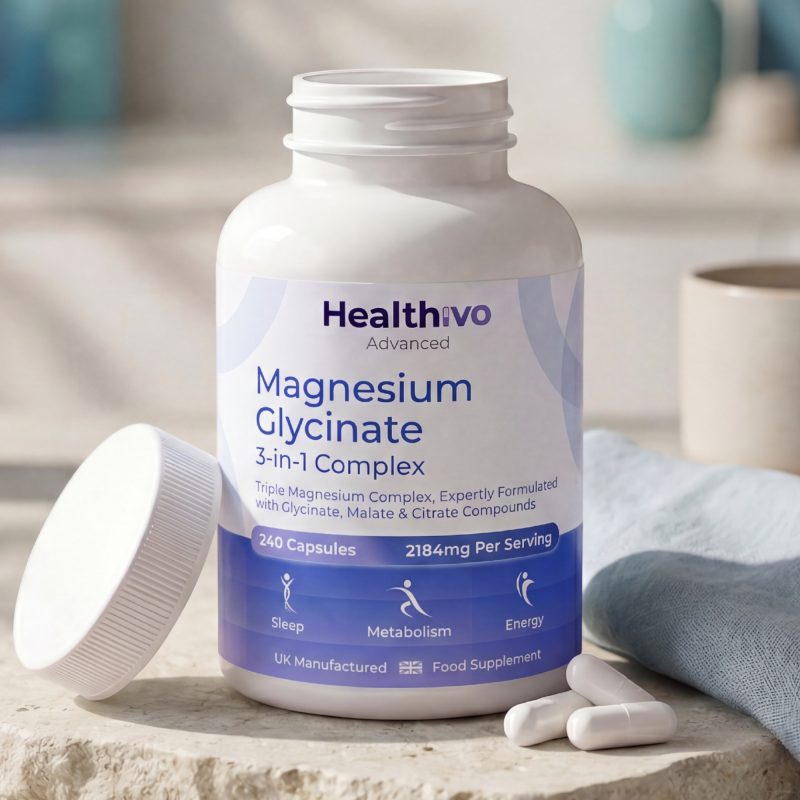
Healthivo's Magnesium Glycinate capsules contains Magnesium in the glycinate form, where magnesium is combined with the amino acid glycine. It’s a good option for people who want a straightforward, single-form magnesium supplement as part of their everyday routine. However, if you are looking for a broader formulation, our Magnesium 3 in 1 brings together three different forms of Magnesium (Glycinate, Citrate and Malate) into one capsule.
Choosing between a single-form glycinate and a 3-in-1 blend therefore comes down largely to the type of formulation you prefer. Whichever option you choose, it is the magnesium itself that provides the established nutritional benefits.

Featured in this post
Magnesium Glycinate
£12.95
Featured in this post
Magnesium Glycinate 3-in-1 Complex
£12.95
Now... Capsules or Gummies?
Then there’s the format itself... For some people, swallowing a magnesium capsule as part of their established morning or evening routine is a simple and quick way to take the supplement. However, others prefer something chewable, which is where our Magnesium Gummies come in.
Our Magnesium Gummies offer a convenient and easy-to-take alternative for anyone who would rather chew their daily magnesium than take a capsule. Our Gummies are raspberry flavored and help to satisfy any sweet cravings after your evening meal which is a win-win!

Featured in this post
Magnesium and Zinc Gummies
£12.95
The Key Takeaway
Whether you opt for Magnesium Gummies, Magnesium Glycinate or our Magnesium 3 in 1 capsules, think of magnesium as a single part of your wider wellbeing routine rather than a quick fix for a poor night’s sleep. Getting enough good-quality sleep still matters! In order to decide which to take, ask yourself the question: "Which form will I remember to take consistently?" And that is the one you should go for!
References
- [1]European Commission (2012) Commission Regulation (EU) No 432/2012 of 16 May 2012 establishing a list of permitted health claims made on foods. Official Journal of the European Union
- [2]European Commission (n.d.) EU Register of Health Claims
- [3]Hudson, A.N., Van Dongen, H.P.A. and Honn, K.A. (2020) ‘Sleep deprivation, vigilant attention, and brain function: a review’, Neuropsychopharmacology, 45, pp. 21–30.
- [4]Mah, J. and Pitre, T. (2021) ‘Oral magnesium supplementation for insomnia in older adults: a systematic review & meta-analysis’, BMC Complementary Medicine and Therapies, 21, 125.
- [5]Rasch, B. and Born, J. (2013) ‘About sleep’s role in memory’, Physiological Reviews, 93(2), pp. 681–766.
- [6]Watson, N.F., Badr, M.S., Belenky, G. et al. (2015) ‘Recommended amount of sleep for a healthy adult: a joint consensus statement of the American Academy of Sleep Medicine and Sleep Research Society’, Sleep, 38(6), pp. 843–844.